
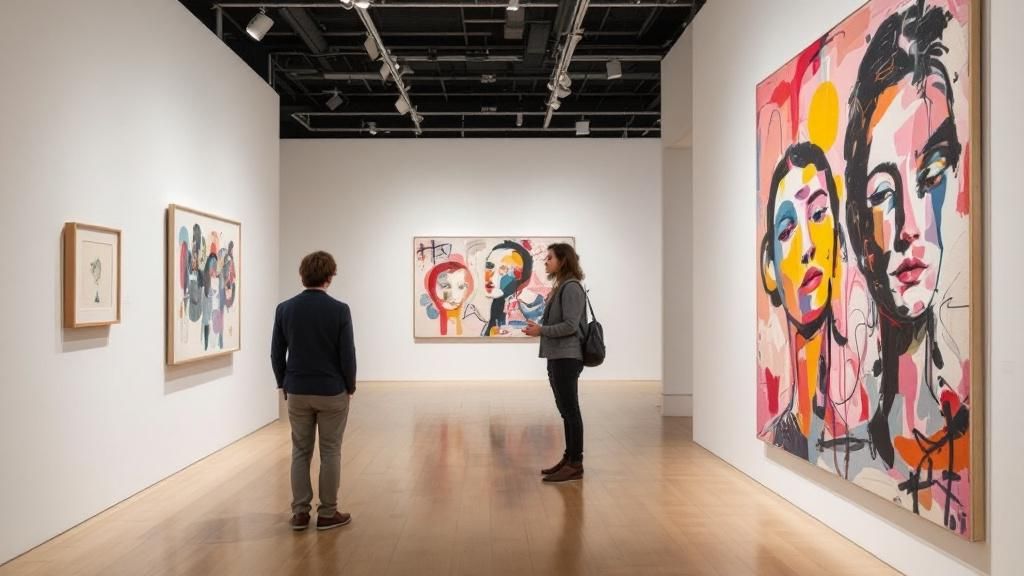
The Turner Prize has functioned as a gauge of modern artistic expression, and this year’s exhibition proves no exception. By showcasing works that deliberately blur the lines dividing abstraction and representation, the curators have crafted a stimulating provocation to viewers’ preconceptions about what art can convey. This article investigates how the featured practitioners utilise unconventional techniques and conceptual frameworks to question our grasp of artistic vocabulary, ultimately considering whether the traditional distinctions between abstract and representational art remain meaningful in the contemporary art world.
Redefining Abstract Boundaries
The Turner Prize display this year intentionally challenges traditional classifications that have traditionally influenced artistic discourse. By showcasing pieces that fluidly move between abstraction and figuration, the curators prompt viewers to question their beliefs about visual meaning-making. The exhibition reveals that contemporary artists increasingly reject binary classifications, instead embracing hybrid approaches that interrogate how we perceive and interpret visual information. This curatorial strategy encourages audiences to think more deeply with artistic intent and aesthetic experience.
These boundary-transcending works reflect a significant evolution within modern artistic practice towards fluid conceptualization and interpretive openness. Rather than conforming to rigid stylistic categories, the featured artists utilise techniques that deliberately destabilise audience expectations. The presentation shows that abstraction and figuration are not mutually exclusive territories but rather positions on a continuous spectrum. This reimagining invites sustained consideration about how meaning emerges through the relationship between artwork, audience perception, and contextual understanding, substantially transforming artistic conversation.
The Development of Graphic Expression
Visual language has undergone significant evolution during the twentieth and twenty-first centuries, particularly as artists engaged with photography’s threat to representational painting. Modernist movements at first established abstraction as a fundamental shift from mimetic traditions, establishing seemingly insurmountable conceptual divides. However, contemporary practitioners now acknowledge these past distinctions as imposed limitations. The exhibition shows how visual language develops naturally, incorporating multiple inspirations and methodologies that move past traditional categorical boundaries, mirroring our increasingly complex visual culture.
Contemporary artists now combine elements from abstraction, representation, and theoretical structures with remarkable complexity. This combined methodology acknowledges that visual communication operates through multiple interpretive pathways simultaneously. The Turner Prize exhibition showcases how artists manipulate tone, structure, arrangement, and symbolic reference to produce layered meanings that defy singular interpretation. This evolution demonstrates that creative vocabulary has matured beyond dogmatic constraints, favouring instead a sophisticated lexicon capable of expressing the intricacies inherent in contemporary experience and perception.
Present-Day Interpretations
Today’s artists explore abstraction with markedly distinct theoretical foundations than their past practitioners, drawing from postmodern theory, digital culture, and international creative traditions. Rather than seeking pure abstraction as an ideological endpoint, modern artists treat abstract forms as means of expression within larger conceptual approaches. The display features artworks where geometric shapes, mark-making, and colour relationships appear together with figurative imagery and textual elements. This multi-faceted approach demonstrates contemporary understanding that visual communication arises from multifaceted exchanges rather than through singular stylistic commitments or stylistic dogmas.
The chosen artists display remarkable facility in engaging with diverse aesthetic modes simultaneously, producing works that repay sustained contemplation and interpretive flexibility. Their work suggests that modern artistic practice increasingly functions as a conversation among artist, artwork, and viewer, rather than as a one-way pronouncement. By integrating diverse visual languages, these artists acknowledge that the creation of meaning in contemporary culture demands sophisticated navigation of competing aesthetic systems. The exhibition ultimately proposes that modern critical understanding requires viewers relinquish rigid categorical thinking, adopting in its place the generative uncertainty that characterises sophisticated artistic practice.
Critical Reception and Public Discourse
The exhibition has sparked considerable conversation amongst critics and art scholars, with responses ranging from strong approval to measured scepticism. Classical advocates have questioned whether the merging of abstract and figurative distinctions amounts to real creative progress or simply aesthetic confusion. Conversely, contemporary perspectives have commended the curatorial team for disrupting entrenched categories that no more reflect contemporary artistic practice. This divergence of opinion demonstrates the exhibition’s role as a catalyst for meaningful discourse within artistic circles and wider society.
Public engagement with the exhibition has surpassed projections, reaching broad demographic segments beyond the established art-world circles. Social media discussion shows that visitors are seriously wrestling with the artistic theoretical foundations, exchanging viewpoints and questioning alternative interpretations. Museums have documented greater attendance and extended viewing times, suggesting that audiences are genuinely invested in deciphering the artists’ intentions. This community-driven interest demonstrates that modern artistic practice can resonate powerfully with the general public when offered adequate contextual framework and cognitive accessibility.
The exhibition’s influence reaches beyond direct assessment by critics, possibly influencing future curatorial practices and artistic direction within institutional structures. New artists have pointed to the exhibition as a watershed moment, validating experimental methods that combine the abstract and the representational. Learning institutions have begun integrating the themes from the exhibition in their teaching programmes, recognising its educational significance. As discussions continue onward, the Turner Prize exhibition seems poised to hold a significant position in contemporary art history, transforming conversations concerning artistic classification and creative potential.
